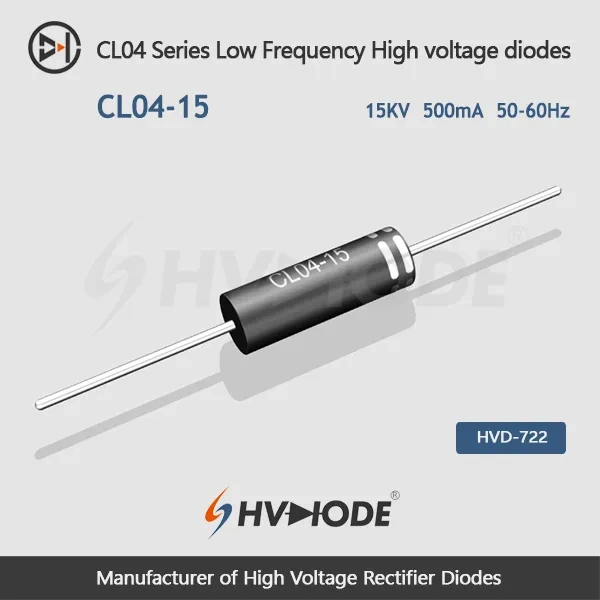
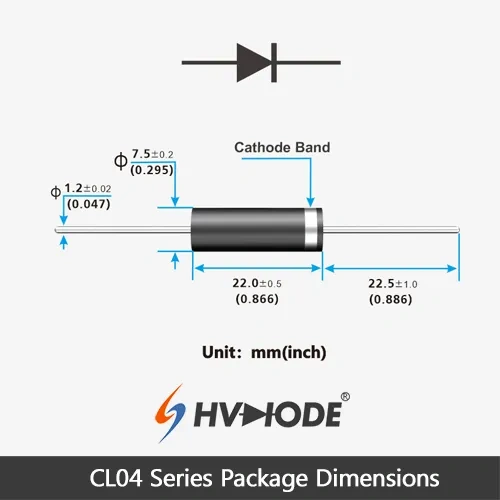
| CL04-15 Low Frequency High voltage diode Data Sheet | ||||
| Parameter | Symbol | Unit | Test Conditions | Value |
| Repetitive Peak Backward Voltage | Vrrm | KV | Ta=25℃ Ir=2.0μA | 15 |
| Peak Working Backward Voltage | Vrwm | KV | Ta=25℃ Ir=2.0μA | 15 |
| Average Forward Current | If(AV) | mA | 50Hz Half-sine Wave , Resistance load @Tbreak=50℃ | 500 |
| Backward Recovery Time | Trr | nS | -- | |
| Surge Forward Current | Ifsm | A | 0.01S @ Half-Sine wave 50Hz | 30 |
| Junction Temperature(MAX) | Ta | ℃ | -40~+150 | |
| Storage Temperature | Tstg | ℃ | -40~+125 | |
| Forward Peak Voltage | Vfm | V | ≥15.0 | |
| Backward Peak Current | Irrm1 | μA | @ Ta=25℃ VRM=VRRM | 2 |
| Irrm2 | μA | @ Ta=100℃ VRM=VRRM | 20.0 | |
| Absolute Maximum Ratings & Electrical Characteristics | ||||
Functional Positioning and Target Users of the CL04-15
The CL04-15 low-frequency high voltage diode is engineered for precise rectification tasks in power supplies, pulsed circuits, and test benches requiring up to 15 kV reverse voltage capacity. This device primarily serves electrical engineers, system integrators, and research laboratories needing consistent high-voltage rectification solutions. Our company's expertise in high voltage diode manufacture guarantees component reliability under continuous operational stress. Its axial leaded configuration facilitates integration into compact modules and prototype systems, addressing the needs of users designing and validating high-voltage equipment.
Technical Features and Measurable Specifications
This specific high voltage diode model features a repetitive peak reverse voltage of 15 kV and an equal peak working reverse voltage rating, ensuring robust insulation and switching capability. Rated with a forward average current of 50 mA and capable of surges up to 30 A (50 Hz half-sine), it supports transient load conditions without compromising performance. Constructed with high-thermal-conductivity epoxy molding and protected by high-temperature resistant chip glue, the device assures thermal stability from -40 to +150 °C junction temperature. Quick-connect terminals and discharge characteristics further enhance its functional dependability, attributes consistent with standards of industry-leading high voltage diode manufacture.
Industry Applications and Real-World Value
This high voltage diode finds extensive application in low-frequency high-voltage rectifier circuits for power supplies, prototype evaluation, laboratory instrumentation, and pulsed power systems. It is essential in sustaining stable voltage measurements and minimizing transient interference within industrial and academic environments. By integrating this diode into rectifier blocks and experimental setups, customers benefit from improved circuit stability and operational longevity. The product aligns with the precision demands of sectors relying on rugged, tested components supplied by respected high voltage diode wholsale providers versed in global research and industrial collaboration.
Structural and Design Advantages of the CL04-15
The diode’s axial leaded design offers straightforward installation in test benches and compact circuit assemblies, facilitating modular system integration. Its epoxy-molded structure maximizes heat dissipation, critical for maintaining junction temperature within safe limits at high voltages. The inclusion of quick-connect terminals simplifies wiring complexity and reduces assembly time, representing efficient engineering in high voltage diode manufacture. High-temperature resistant chip protective glue further protects the die during voltage surges, ensuring structural resilience. These design choices reflect a purposeful approach to creating durable components with high reliability standards sought in high voltage diodes.
Performance and Usability Benefits for End Users
Functionally, the diode supports repetitive peaks at 15 kV and accommodates surge currents up to 30 A, which equips electrical systems with dependable protection against transient conditions and voltage spikes. Its fast recovery time and discharge characteristics enhance circuit performance, while operating temperature tolerance enables use in varied environmental conditions. End users experience consistent, uninterrupted device operation, reducing downtime and maintenance efforts. The product’s configuration enables easy incorporation into diverse HV electronic modules, underscoring its value proposition for specialists sourcing from trusted high voltage diode wholsale vendors.
What are the key electrical ratings of the CL04-15 diode?
The CL04-15 diode provides a repetitive peak reverse voltage (Vrrm) and peak working reverse voltage (Vrwm) of 15 kV each. It supports an average forward current of 50 mA and a surge forward current of up to 30 A (50 Hz half-sine), ensuring stable operation in high voltage systems requiring durable diode performance.
Can HVDIODE customize high voltage diodes for specific industrial applications?
Yes, HVDIODE offers customization for high voltage diodes and silicon stack components tailored to client specifications. With a professional R&D team and multiple national patents, custom designs can address specialized voltage, current, and packaging requirements for various industrial needs.
How is the CL04-15 diode mounted and connected in circuits?
The CL04-15 features axial leaded connections with quick-connect terminals, allowing straightforward wiring and integration into compact high-voltage modules. This design supports easy replacement and assembly in low-frequency, high-voltage rectifier circuits commonly used in test benches and lab equipment.
What quality certifications and testing ensure the reliability of HVDIODE products?
HVDIODE (Anshan Shuli Electronics Co., Ltd.) holds ISO9001 certification and complies with RoHS and SGS standards. Their manufacturing includes multi-voltage-level high-voltage test benches, temperature chambers, and surge test equipment, providing precise parameter verification to guarantee the reliability of high voltage diode components supplied worldwide.
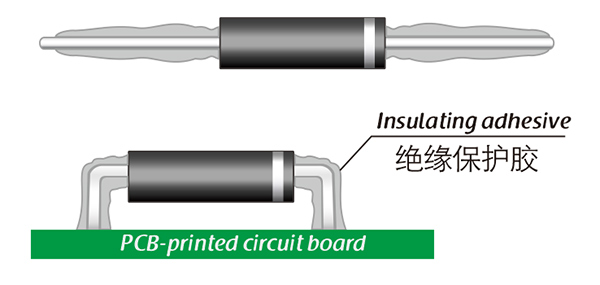
Here, suitable insulation adhesive materials can be selected based on the different usage situations of engineers.