• HVRM-Series Axial Lead  Power Frequency  Glass Passivated High Voltage Diodes
  • HVRM-Series Axial Lead  Power Frequency  Glass Passivated High Voltage Diodes

HVRM-Series Axial Lead Power Frequency Glass Passivated High Voltage Diodes

Params Range:1-15KV;0.8-10A;
$0.00
型号:Type:
HVRM1(1KV ; 10A)
HVRM2(2KV ; 5A)
HVRM3(3KV ; 3A)
HVRM4(4KV ; 3A)
HVRM5(5KV ; 2A)
HVRM6(6KV ; 2A)
HVRM7(7KV ; 1.5A)
HVRM8(8KV ; 1.5A)
HVRM9(9KV ; 1.5A)
HVRM10(10KV ; 1A)
HVRM11(11KV ; 1A)
HVRM12(12KV ; 1A)
HVRM13(13KV ; 0.8A)
HVRM14(14KV ; 0.8A)
HVRM15(15KV ; 0.8A)
Frequency:
50-60Hz
  • HVRM-Series Axial Lead  Power Frequency  Glass Passivated High Voltage Diodes
  • Desciption

  • data sheet

  • Installation Guide


HVRM-Series  Axial Lead  Power Frequency  Glass-passivated High-Voltage Diodes (1-15KV;0.8-10A;50/60Hz)

Type Vrrm(KV) If(mA) Vfm(V) Ifsm(A) Trr(nS) Irrm1/Irrm2(uA) Dimensions Photo
Condition Ta=25℃ Ir=2uA Ta=25℃ Max tp=8.3ms 50℃   Ta=25℃/100℃ Φ1*L(mm) 
HVRM1 1.0 10.0 2.0 200 150 2/20 9×9
HVRM2 2.0 5.0 3.0 100 150 2/20 9×9
HVRM3 3.0 3.0 4.5 60 150 2/20 9×9
HVRM4 4.0 3.0 5.0 60 150 2/20 9×9
HVRM5 5.0 2.0 7.5 60 150 2/20 9×9
HVRM6 6.0 2.0 7.5 40 150 2/20 9×9
HVRM7 7.0 1.5 10.0 40 150 2/20 9×9
HVRM8 8.0 1.5 11.0 40 150 2/20 9×9
HVRM9 9.0 1.5 12.0 20 150 2/20 9×9
HVRM10 10.0 1.0 15.0 20 150 2/20 9×9
HVRM11 11.0 1.0 15.0 20 150 2/20 9×9
HVRM12 12.0 1.0 16.0 20 150 2/20 9×9
HVRM13 13.0 0.8 19.0 20 150 2/20 9×9
HVRM14 14.0 0.8 19.0 20 150 2/20 9×9
HVRM15 15.0 0.8 20.0 20 150 2/20 9×9
Parameter customization, please contact our customer service: sales@hvdiode.com
The selection of high-voltage diodes is closely related to their usage environment。

1. Used in insulating oil. (Recommended)
2. Used in insulating gases. (Recommended)
3. Secondary packaging use. (High requirements for heat dissipation and other parameter performance of components)
4. Use in exposed air or add air cooling. (If the size of the high-voltage diode is small, it is easy to discharge, and the heat dissipation performance is average.)

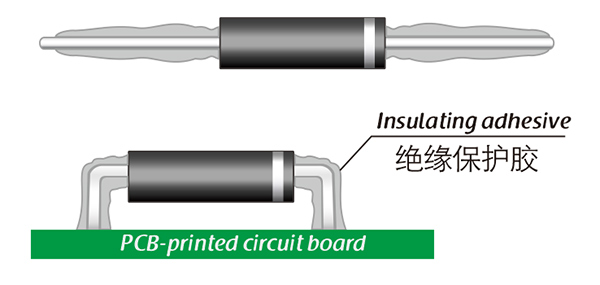
For high-voltage diodes used in exposed air, it is recommended to install them with insulated electrodes at both ends.


Common treatment methods for surface adhesive insulation:

Characteristics of insulation adhesive material:

1. Silicone material usually presents a transparent and elastic rubber state after curing, which is more effective in shock resistance and can also withstand severe stress changes caused by large high and low temperature changes (-40 ° C~200 ° C).

2. Acrylic materials typically exhibit a transparent and hard coating after curing, with low moisture absorption and fast curing time, as well as excellent wear resistance and insulation.

3. After curing, Urethane material usually presents a transparent and hard coating, which has superior wear resistance and good moisture resistance. Its performance is particularly stable in low temperature environments, but it is less resistant to high temperatures.

4. The coating material based on epoxy is very sturdy and usually opaque, with good moisture and moisture resistance. Its resistance to chemical corrosion and wear is also very good. In addition, epoxy also has good dielectric properties.

Here, suitable insulation adhesive materials can be selected based on the different usage situations of engineers.

HVDIODE - Suly Electronics Co., Ltd.

Expects To Provide You With Perfect Service

Name
Email*
Verification Code*
Verification Code
Leave a message
Name
Email*
Message
Verification Code*
Verification Code
We use Cookie to improve your online experience. By continuing browsing this website, we assume you agree our use of Cookie.