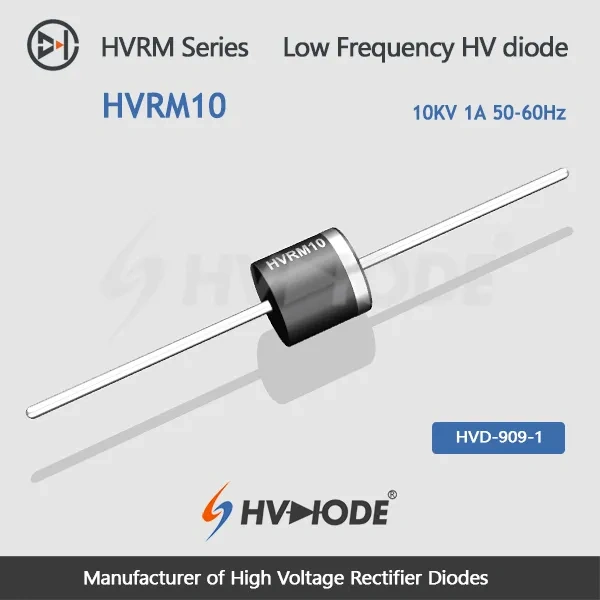
• HVRM10- Low frequency high voltage diode 10KV,1.0A,50-60Hz
  • HVRM10- Low frequency high voltage diode 10KV,1.0A,50-60Hz
  • HVRM10- Low frequency high voltage diode 10KV,1.0A,50-60Hz
  • HVRM10- Low frequency high voltage diode 10KV,1.0A,50-60Hz
  • HVRM10- Low frequency high voltage diode 10KV,1.0A,50-60Hz
  • HVRM10- Low frequency high voltage diode 10KV,1.0A,50-60Hz
  • HVRM10- Low frequency high voltage diode 10KV,1.0A,50-60Hz
  • HVRM10- Low frequency high voltage diode 10KV,1.0A,50-60Hz

HVRM10- Low frequency high voltage diode 10KV,1.0A,50-60Hz

Products Main features:
1、Axial leaded connection.
2、High thermal conductivity epoxy compound molding.
3、Excellent surge current resistance
4、Special high temperature resistant chip
  • HVRM10- Low frequency high voltage diode 10KV,1.0A,50-60Hz
  • HVRM10- Low frequency high voltage diode 10KV,1.0A,50-60Hz
  • HVRM10- Low frequency high voltage diode 10KV,1.0A,50-60Hz
  • HVRM10- Low frequency high voltage diode 10KV,1.0A,50-60Hz
  • Desciption

  • data sheet

  • Installation Guide

 HVRM10  Low frequency high voltage diode Data Sheet 
 Parameter Symbol Unit Test Conditions Value
 Repetitive Peak Backward Voltage Vrrm KV Ta=25℃  Ir=2.0μA 10
 Peak Working Backward Voltage Vrwm KV Ta=25℃  Ir=2.0μA 10
 Average Forward Current If(AV) A 50Hz Half-sine Wave , Resistance load @Tbreak=50℃ 1.0
 Backward Recovery Time Trr nS   --
 Surge Forward Current Ifsm A 0.01S @ Half-Sine wave  50Hz 100
 Operating Ambient Temperature Ta ℃   -55~+175
 Storage Temperature Tstg ℃   -55~+150
 Forward Peak Voltage Vfm V   ≥12.0
 Backward Peak  Current Irrm1 μA @ Ta=25℃ VRM=VRRM 2.0
Irrm2 μA @ Ta=100℃ VRM=VRRM 20.0
 Absolute Maximum Ratings & Electrical Characteristics


Construction & Thermal Design

  • Axial leaded connection — the leads solder into a through-hole position and hold the molded body clear of the board, which keeps cleaning and coating straightforward after assembly.
  • High thermal conductivity epoxy molding — the compound pulls heat away from the chip and seals it against moisture, which is what you want when a high voltage diode ends up inside a sealed enclosure that cannot be opened for inspection.
  • High temperature resistant chip — the junction is made for hot running conditions, so the part keeps its blocking behaviour in equipment where heat has nowhere to escape.
  • Surge current resistance — the diode is built to absorb the short, heavy current pulse that appears when a high-voltage capacitor bank charges at switch-on.

Mounting Environments

  1. In insulating oil — the recommended arrangement. The oil fills the space around the body, suppresses discharge and carries heat away from the molded package, so an oil-filled tank is a natural home for this diode.
  2. In insulating gas — also recommended. Keep the gas dry and the surfaces clean, and leave enough room around the body and the leads for the field to stay stable.
  3. Potted or secondary-packaged assemblies — here the potting compound becomes part of the cooling path, so small high voltage diodes in this layout need a compound chosen for heat dissipation as well as for electrical insulation.
  4. In open air or with forced air cooling — workable but the least forgiving option: a small body can discharge at high voltage and the heat path is only average. For diodes used in exposed air, mount them with insulated electrodes at both ends.

Technical Support & Model Matching

Selection support starts before you order. Our technical team reviews your working voltage, forward current, surge and thermal conditions against the published datasheets, then recommends the closest high-voltage diode and confirms the matching part number. We also guide you through installation and insulation considerations, and help troubleshoot issues during qualification or after delivery. Suly Electronics manufactures these diodes directly, supplies them in bulk, and keeps answering technical questions for the parts you already use.

FAQ

Q1. Is this a low-frequency diode or a fast-recovery diode?

This is a 50-60 Hz power-frequency high voltage diode, designed for rectification rather than high-frequency switching. No reverse recovery time is published for this part, which is normal for the HVRM power-frequency range. If your circuit switches at high frequency, send us the switching conditions and we will point you to a fast-recovery series instead.

Q2. What is the difference between the 10 kV part and the 11 kV version in the same range?

The two parts share the same current rating, so the difference comes down to reverse voltage margin. The 11 kV version gives extra headroom where the working voltage sits close to 10 kV or where the transient peaks are not fully characterised. At 10 kV, this diode matches designs whose peaks are already covered with room to spare.

Q3. Can I replace a failed 10 kV diode from another maker with this part?

In most cases yes, provided the original carried a similar blocking voltage and average current and mounted the same way. Send us the marking from the old diode along with your working voltage, current and mounting conditions, and we will confirm the match before you commit to a build.

Q4. Can I order a different lead form or lead length?

The standard part is supplied with axial leads. If your line needs a particular lead length, forming or marking, describe it when you enquire and we will confirm what can be done with our current tooling before you plan the assembly around it.

Q5. Does it work on 60 Hz supplies as well as 50 Hz?

Yes — the range covers 50-60 Hz rectification. The published test conditions use a 50 Hz half-sine waveform, so if your design runs at 60 Hz, tell us the load and the duty and we will confirm the operating envelope for your particular build.

Q6. Can two of these diodes be used in series for a higher blocking voltage?

Series operation is a system design decision rather than a matter of stacking parts. How the voltage divides between high voltage diodes in the string, and how they are cooled, both affect the result. Send us your working voltage, the medium the diodes sit in and the layout you have in mind, and we will advise on the configuration.
The selection of high-voltage diodes is closely related to their usage environment。

1. Used in insulating oil. (Recommended)
2. Used in insulating gases. (Recommended)
3. Secondary packaging use. (High requirements for heat dissipation and other parameter performance of components)
4. Use in exposed air or add air cooling. (If the size of the high-voltage diode is small, it is easy to discharge, and the heat dissipation performance is average.)

For high-voltage diodes used in exposed air, it is recommended to install them with insulated electrodes at both ends.


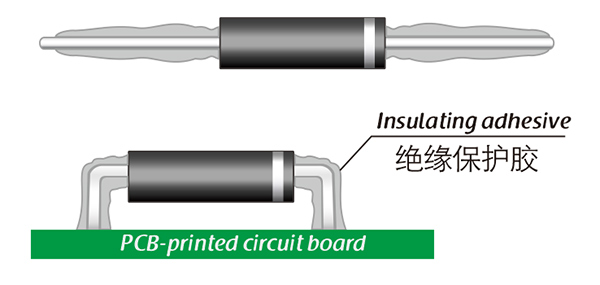
Common treatment methods for surface adhesive insulation:

Characteristics of insulation adhesive material:

1. Silicone material usually presents a transparent and elastic rubber state after curing, which is more effective in shock resistance and can also withstand severe stress changes caused by large high and low temperature changes (-40 ° C~200 ° C).

2. Acrylic materials typically exhibit a transparent and hard coating after curing, with low moisture absorption and fast curing time, as well as excellent wear resistance and insulation.

3. After curing, Urethane material usually presents a transparent and hard coating, which has superior wear resistance and good moisture resistance. Its performance is particularly stable in low temperature environments, but it is less resistant to high temperatures.

4. The coating material based on epoxy is very sturdy and usually opaque, with good moisture and moisture resistance. Its resistance to chemical corrosion and wear is also very good. In addition, epoxy also has good dielectric properties.

Here, suitable insulation adhesive materials can be selected based on the different usage situations of engineers.

HVDIODE - Suly Electronics Co., Ltd.

Expects To Provide You With Perfect Service

Name
Email *
Verification Code *
Verification Code
Leave a message
Name
Email *
Message
Verification Code *
Verification Code
We use Cookie to improve your online experience. By continuing browsing this website, we assume you agree our use of Cookie.