| HVRM7 Low frequency high voltage diode Data Sheet | ||||
| Parameter | Symbol | Unit | Test Conditions | Value |
| Repetitive Peak Backward Voltage | Vrrm | KV | Ta=25℃ Ir=2.0μA | 7 |
| Peak Working Backward Voltage | Vrwm | KV | Ta=25℃ Ir=2.0μA | 7 |
| Average Forward Current | If(AV) | A | 50Hz Half-sine Wave , Resistance load @Tbreak=50℃ | 1.5 |
| Backward Recovery Time | Trr | nS | -- | |
| Surge Forward Current | Ifsm | A | 0.01S @ Half-Sine wave 50Hz | 150 |
| Operating Ambient Temperature | Ta | ℃ | -55~+175 | |
| Storage Temperature | Tstg | ℃ | -55~+150 | |
| Forward Peak Voltage | Vfm | V | ≥8.5 | |
| Backward Peak Current | Irrm1 | μA | @ Ta=25℃ VRM=VRRM | 2.0 |
| Irrm2 | μA | @ Ta=100℃ VRM=VRRM | 20.0 | |
| Absolute Maximum Ratings & Electrical Characteristics | ||||
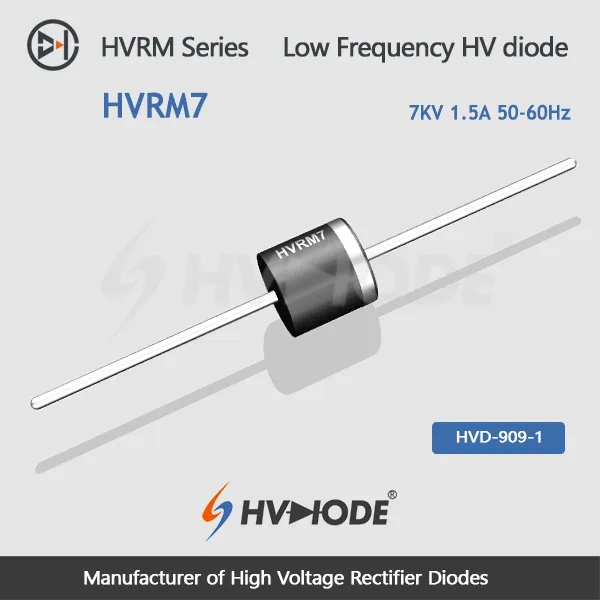
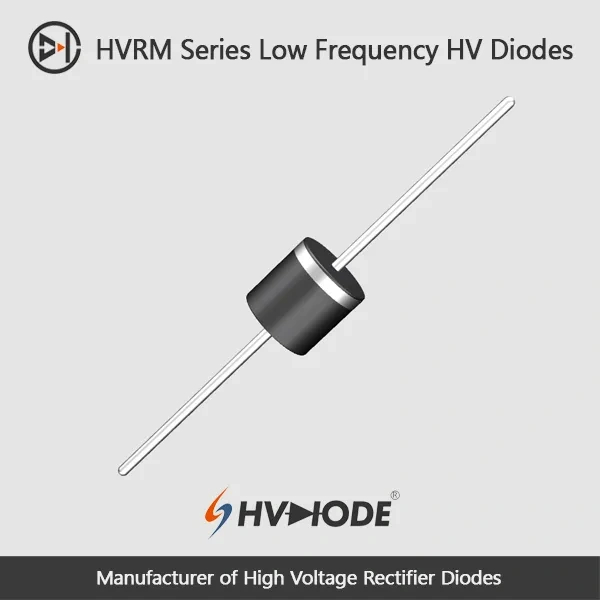
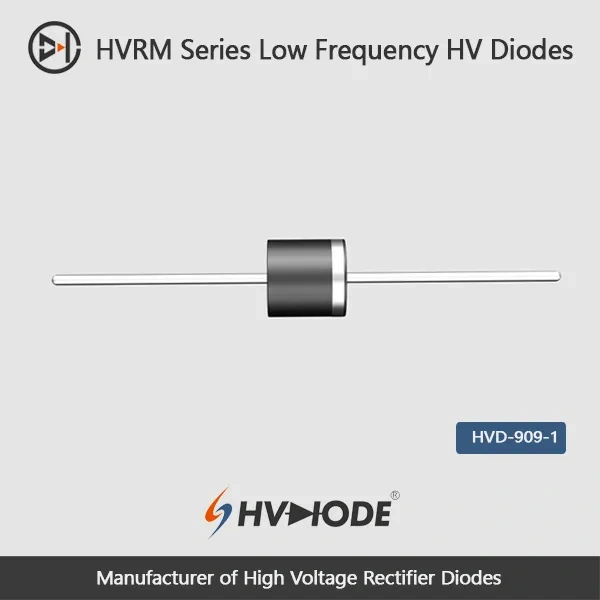
HVRM7 is a 7KV, 1.5A low frequency high voltage diode for 50-60 Hz rectification in high-voltage supplies and rectifier assemblies. It uses an axial leaded connection, so it can sit through a board or be wired into a stack, and the body is molded in a high thermal conductivity epoxy compound that carries heat away from the chip. A high-temperature resistant chip and a surge-rated junction let this diode ride through the inrush and fault currents that line-frequency rectifiers meet. The part belongs to the HVRM-Series of power frequency diodes, a family that runs from 5KV to 15KV, and it ships with a published data sheet so every rating can be checked against your circuit.
Selection support starts before you order. Our technical team reviews your working voltage, forward current, surge and thermal conditions against the published datasheets, then recommends the closest high-voltage diode and confirms the matching part number. We also guide you through installation and insulation considerations, and help troubleshoot issues during qualification or after delivery. Suly Electronics manufactures these diodes directly, supplies them in bulk, and keeps answering technical questions for the parts you already use.
No — this is a low-frequency part designed for 50-60 Hz rectification, and its recovery time is left unspecified because line frequency is the intended working condition. If your circuit switches at kilohertz or faster, step up to one of our fast recovery or ultra fast recovery high voltage diode families.
They are consecutive steps in the same family. The 6KV part carries 2 A of average forward current with a larger surge rating; this 7KV model trades some of that current for more blocking voltage at 1.5 A; the 8KV version holds 1.5 A while raising the voltage again. All three share the molded construction and the same document set, with the differences sitting in the voltage rating and the current each one carries.
Yes. This is a power-frequency rectifier diode, and it suits bridge legs and series stacks where several high voltage diodes work together to hold the string voltage. Because it is a single diode, the stack design determines how the voltage divides. Keep the leads short and space the string so each body can shed heat rather than trapping it in the middle.
Form the leads at a comfortable distance from the body rather than right at the seal, and avoid bending the same spot back and forth. Keep the body and the lead entry clean before any coating goes on — finger oils and flux residue left on the surface are a common cause of discharge in high-voltage work.
The part is specified for 50-60 Hz operation, and its ratings are measured on a 50 Hz half-sine wave with a resistive load. Running it on a 60 Hz supply sits inside the intended use; check the peak and surge conditions against your load in the same way you would at 50 Hz.
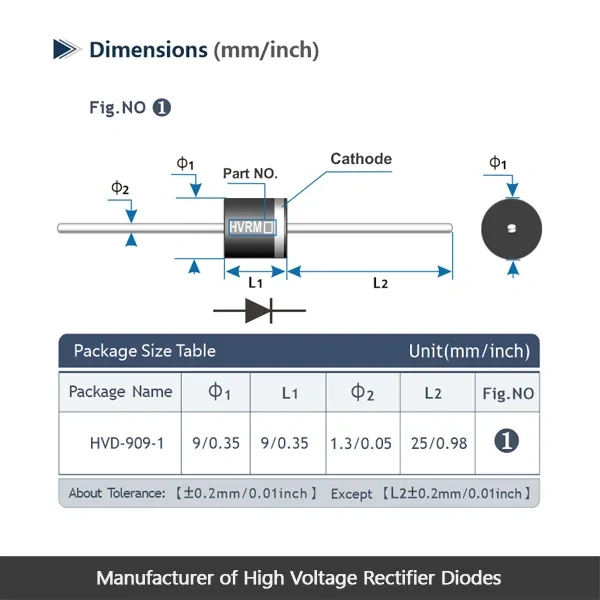
Start by matching the two backward voltage ratings, the average forward current and the lead connection against the data sheet, then check that the body outline and lead pitch fit your board or stack. If the failed part is hard to identify, send a photo or drawing and our engineers will compare it with the sheet.
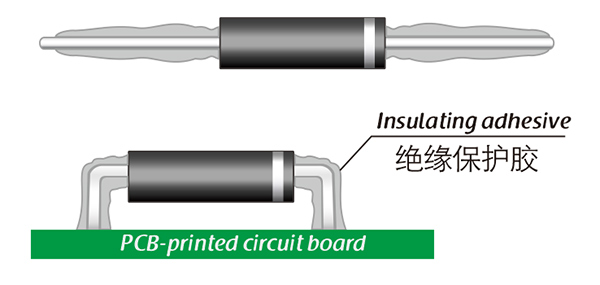
Here, suitable insulation adhesive materials can be selected based on the different usage situations of engineers.