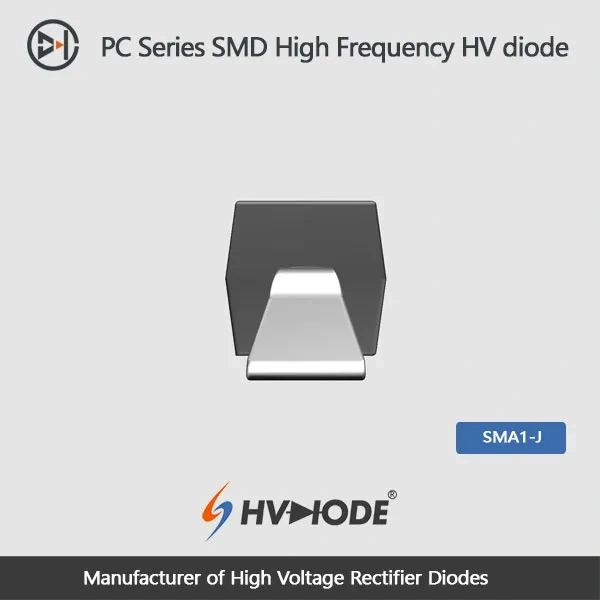
| PC3Q SMD high voltage diode Data Sheet | ||||
| Parameter | Symbol | Unit | Test Conditions | Value |
| Repetitive Peak Backward Voltage | Vrrm | KV | Ta=25℃ Ir=1.0μA | 3 |
| Peak Working Backward Voltage | Vrwm | KV | Ta=25℃ Ir=1.0μA | 3 |
| Average Forward Current | If(AV) | mA | 50Hz Half-sine Wave , Resistance load @Tbreak=50℃ | 700 |
| Backward Recovery Time | Trr | nS | 75 | |
| Surge Forward Current | Ifsm | A | 0.01S @ Half-Sine wave 50Hz | 10 |
| Operating Ambient Temperature | Ta | ℃ | -55~+175 | |
| Storage Temperature | Tstg | ℃ | -55~+150 | |
| Forward Peak Voltage | Vfm | V | ≥2.8 | |
| Backward Peak Current | Irrm1 | μA | @ Ta=25℃ VRM=VRRM | 1.0 |
| Irrm2 | μA | @ Ta=100℃ VRM=VRRM | 20.0 | |
| Absolute Maximum Ratings & Electrical Characteristics | ||||
Functional Integration for Compact High Voltage Designs
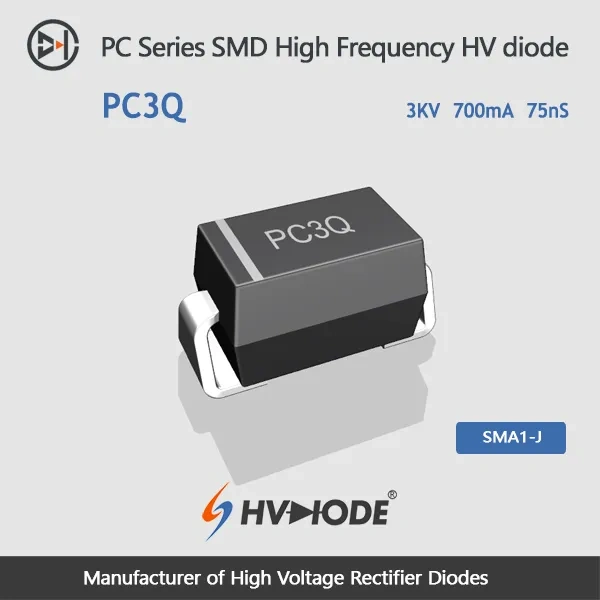
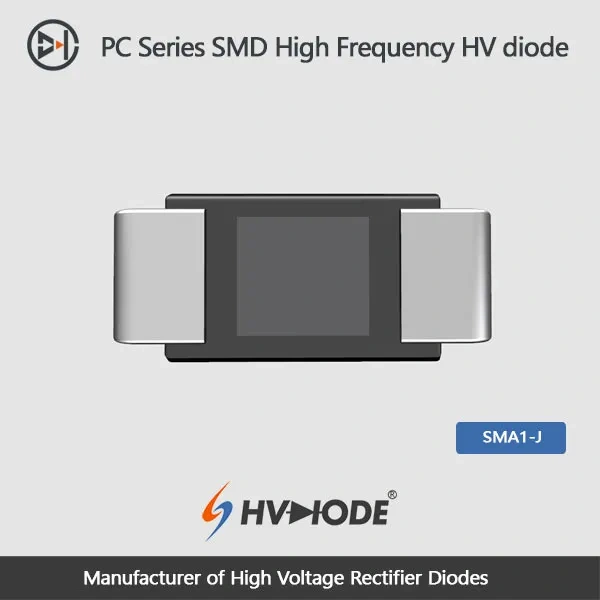
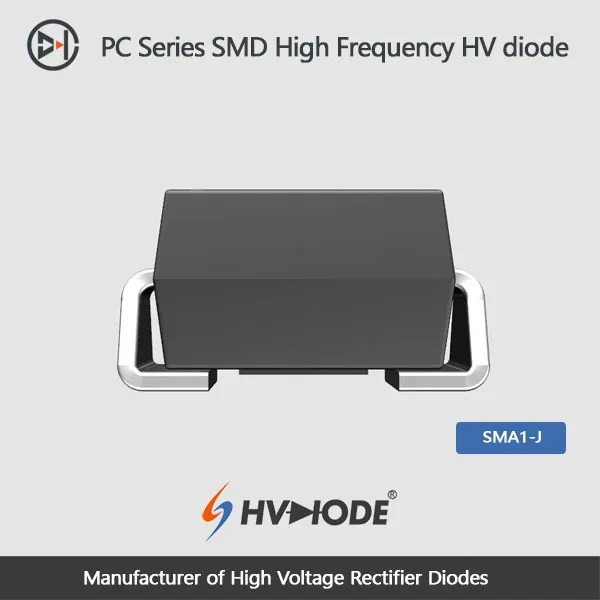
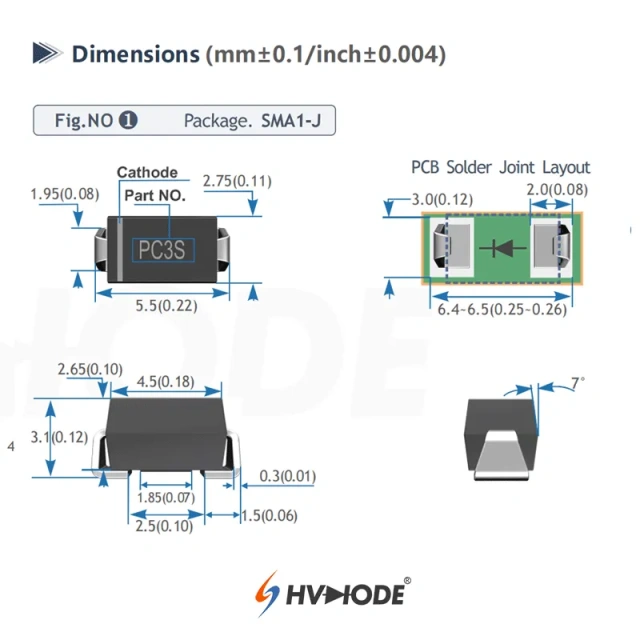
The PC3Q high voltage diode delivers a surface-mount solution tailored for engineers and procurement teams targeting compact, high-voltage rectification circuits. Its ultra-small SMD package with J-Lead inner bend enables seamless PCB integration, providing design consistency where board space is constrained. Intended for applications requiring reliable fast recovery characteristics, this component addresses stringent engineering demands for dense power systems. Its incorporation facilitates streamlined assembly processes and reduces the complexity often encountered in high voltage diode manufacture, thereby optimizing supply chain efficiency for high voltage diode wholsale customers.
Technical Specifications Driving High Efficiency and Reliability
Featuring a repetitive peak backward voltage of 3 kV and an average forward current rating of 700 mA, the PC3Q offers precise electrical parameters critical for high voltage diode performance. Its 75 ns backward recovery time minimizes switching losses, enhancing overall system efficiency. The high thermal conductivity epoxy molding supports operational stability across a wide temperature range from -55 to +175 °C, ensuring durability under demanding electrical stress. These measurable specifications reflect a robust design philosophy, supported by comprehensive testing protocols, making the diode a dependable choice for engineers developing resilient, high-performance rectifier circuits.
Industrial Applications in Modern Power Electronics
This high voltage diode is suited to a broad spectrum of high voltage power supply designs, pulsed power systems, and compact HV testing equipment. Its fast recovery capability supports high-frequency switching environments encountered in industrial HV rectifiers and compact pulse power units. The component’s uniform package dimensions across the PC Series simplify component sourcing and replacement, facilitating maintenance and lifecycle management. Deployed in critical infrastructures and research institutions, this high voltage diode boosts system reliability while enabling precise high voltage diode manufacture processes to meet stringent operational standards.
Design Innovation Enabling Compact System Integration
The structural design of the PC3Q emphasizes a space-efficient SMD format with J-Lead inner bend leads, allowing high-density circuit layouts without compromising electrical robustness. The use of high thermal conductivity epoxy molding enhances heat dissipation, crucial for maintaining consistent diode operation in high voltage environments. Modular package sizing across the PC Series allows for interchangeable configurations, streamlining design adjustments and inventory management for high voltage diode wholsale distributors. This systematic approach reflects an integration-focused design philosophy, supporting scalable manufacturing and enhanced circuit board compatibility.
Optimized Performance for Engineering Reliability and Efficiency
Performance-wise, the PC3Q delivers a fast 75 ns recovery time that reduces switching losses and enhances circuit efficiency, directly benefiting power conversion systems. Its rated 3 kV peak voltage and 700 mA average forward current capacity align with demanding application parameters, offering predictable, high-reliability operation. Furthermore, the diode maintains functionality in extreme temperature conditions, complying with industry standards for high voltage diode manufacture. Ease of SMT placement and consistent electrical characteristics also contribute significant value to system designers seeking dependable, repeatable results in high voltage diode wholsale markets.
What is the typical application environment for the PC3Q high voltage diode?
The PC3Q diode, with its ultra-small surface-mount design and high thermal conductivity epoxy molding, is ideal for compact high-voltage power supplies, pulsed power units, and dense PCB assemblies requiring fast recovery high voltage diodes designed for reliable operation under demanding switching conditions.
Can the specifications of PC3Q SMD high voltage diode be customized for specific requirements?
Yes, all models and parameters of high voltage diodes, including the PC3Q, can be customized. HVDIODE offers tailored solutions to meet specific electrical, thermal, and mechanical requirements, ensuring precise performance for industrial designs involving high voltage diode manufacture.
What certifications and quality controls assure the reliability of PC3Q diodes?
HVDIODE complies with ISO9001 quality management and holds RoHS and SGS certifications. The PC3Q undergoes rigorous testing including high voltage, high and low temperature, surge, and recovery time assessments, ensuring consistent quality and performance aligned with industry standards in high voltage diodes production.
How should the PC3Q diode be integrated into PCB assemblies for optimal performance?
The PC3Q diode’s J-Lead inner bend and compact SMD connection enable easy surface mounting in dense PCB layouts. Proper soldering techniques and thermal management are recommended to maintain stability within operating temperature ranges from -55 to +175°C, ensuring reliable high voltage diode rectification performance.
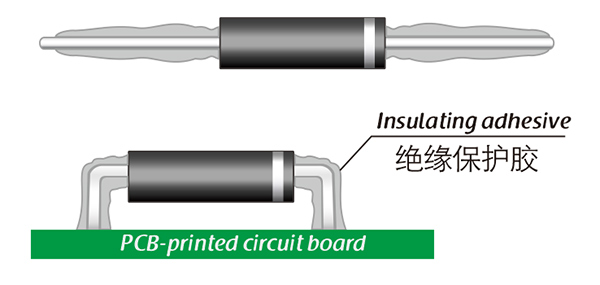
Here, suitable insulation adhesive materials can be selected based on the different usage situations of engineers.